In the contemporary landscape of organizational psychology, leadership is increasingly viewed not as a static rank or a collection of technical competencies, but as a journey of psychological expansion. While traditional management training focuses heavily on «hard skills»—budgeting, strategic planning, and performance metrics—there remains a profound, often untaught curriculum regarding the internal evolution of a leader. A compelling conceptual framework, titled «The Leadership Lessons No One Taught You,» illustrates this evolution through five concentric circles: the Control Zone, the Doubt Zone, the Reflection Zone, the Trust Zone, and the Impact Zone.
This model posits that a leader’s effectiveness is inversely proportional to their need for personal control. As a leader matures, they move from the center of the circle (the self) toward the outer edges (the legacy). The following analysis explores these five zones, the psychological shifts required to transition between them, and the ultimate destination of high-impact leadership.
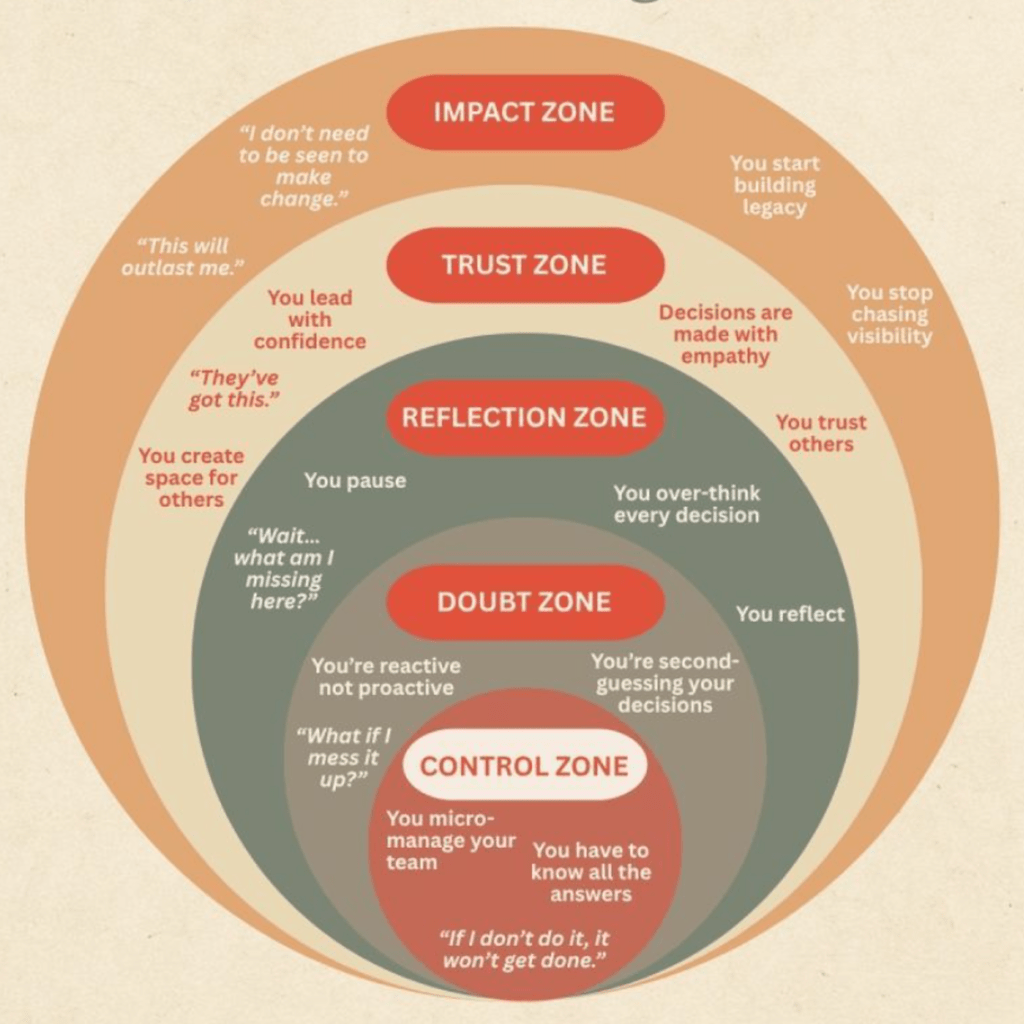
The inner core: The Control Zone
The center of the model is the Control Zone, characterized by the pervasive belief: «If I don’t do it, it won’t get done.» This is the starting point for many high-achievers who have been promoted into leadership roles based on their individual technical brilliance. Because their identity is tied to being «the expert,» they find it difficult to relinquish tasks to others.
In this zone, leadership is synonymous with micromanagement. The leader feels a compulsive need to know every detail and have all the answers. While this provides a temporary sense of security, it creates a massive bottleneck for the organization. Team members in the Control Zone often feel suffocated, leading to a lack of initiative and a «waiting for orders» culture. For the leader, this stage is exhausting and unsustainable, eventually leading to burnout as the complexity of the organization outpaces the individual’s capacity to monitor it.
The liminal space: The Doubt Zone
As the leader realizes that total control is an illusion, they often slide into the Doubt Zone. This is a precarious and uncomfortable stage where the old habits of control no longer work, but the new habits of delegation have not yet taken root.
The hallmark of this zone is reactivity. Because the leader is no longer micromanaging everything but hasn’t yet built a system of trust, they spend their time putting out fires. They second-guess their decisions, haunted by the question, «What if I mess it up?» This is where «analysis paralysis» often sets in. The leader is aware of their limitations but lacks the confidence to empower others to bridge the gap. It is a stage of high anxiety but low productivity, acting as a necessary «breaking point» that forces the leader to look inward.
The turning point: The Reflection Zone
To move out of the Doubt Zone, a leader must enter the Reflection Zone. This represents a fundamental shift from doing to thinking. In this zone, the leader learns the power of the «strategic pause.» Instead of reacting to a crisis, they stop and ask: «Wait… what am I missing here?»
Reflection allows the leader to identify their own biases and the limitations of their perspective. It is here that the leader begins to over-think, which, while frustrating, is a sign of increasing intellectual humility. They begin to value the input of others not just as a labor force, but as a cognitive resource. By creating space for others to speak and contribute, the leader begins to dismantle the «expert» identity that kept them trapped in the Control Zone. Reflection is the gateway to empathy and complexity.
The expansion: The Trust Zone
When reflection leads to the realization that the team is capable, the leader enters the Trust Zone. This is the stage where true leadership begins to scale. The internal monologue shifts from «I need to do this» to «They’ve got this.»
In the Trust Zone, decisions are made with empathy rather than ego. The leader leads with confidence—not a confidence in their own answers, but a confidence in the team’s collective ability to find them. The most significant indicator of this zone is the cessation of «visibility chasing.» A leader in the Trust Zone does not need to be the loudest voice in the room or take credit for every success. They find satisfaction in the growth of their subordinates. This creates a high-autonomy environment where innovation flourishes because team members feel safe enough to take risks.
The outer reach: The Impact Zone
The final stage of the model is the Impact Zone. This is the realm of the «Level 5 Leader,» a term coined by Jim Collins to describe executives who combine extreme personal humility with intense professional will. In the Impact Zone, the leader is focused on building a legacy.
The defining thought here is: «This will outlast me.» The leader recognizes that their greatest contribution is not what they achieve during their tenure, but how the organization functions after they are gone. They no longer need to be seen to make a change; they are content to be the «invisible hand» that guides the culture and removes obstacles. Leadership in this zone is about institutionalizing values, developing the next generation of leaders, and ensuring that the mission remains clear. The Impact Zone is where a leader’s influence becomes exponential rather than linear.
The three fundamental shifts
Navigating these five zones requires three fundamental shifts in the leader’s psychological architecture:
1. From Individual Contributor to Orchestrator
The most difficult transition is moving from the Control Zone to the Reflection Zone. It requires a death of the «ego of the doer.» Many leaders fail here because they cannot find a new way to feel valuable. If they aren’t the ones «doing,» who are they? The successful leader learns that their value now lies in orchestration—aligning the right people with the right tasks and creating the conditions for success.
2. From Certainty to Inquiry
In the lower zones, the leader feels they must have the answers to be respected. In the higher zones (Reflection and Trust), the leader realizes that the most powerful tool is the question. By shifting from a stance of certainty to one of inquiry, the leader invites the team into a collaborative process. This not only leads to better decisions but also facilitates the professional development of the team.
3. From Presence to Principles
In the Control and Doubt zones, the leader must be physically or virtually «present» for everything to function. In the Impact Zone, the leader’s principles take the place of their physical presence. When a leader has successfully instilled a clear vision and a set of shared values, the team can make high-quality decisions in the leader’s absence. This is the ultimate form of organizational maturity.
The goal of disappearing
The paradox of the «Leadership Lessons No One Taught You» model is that the more successful a leader becomes, the less «necessary» they should be for day-to-day operations. The journey from the Control Zone to the Impact Zone is a journey of becoming a steward of a system rather than a master of a task.
For organizations, this model provides a roadmap for leadership development. It suggests that we should not only measure leaders by the ROI of their projects but by the «zone» in which they operate. A leader who delivers short-term results through micromanagement in the Control Zone is ultimately a liability, as they leave the organization fragile and their team depleted. Conversely, a leader who operates in the Impact Zone leaves behind a resilient, autonomous, and purpose-driven culture.
Ultimately, the lesson that is rarely taught is that the greatest act of leadership is to build something so strong, so trusted, and so reflective of shared values that the leader themselves eventually becomes the least important part of the machine. That is the essence of building a legacy.
 DREIESKIVA|Roald Kvam
Legg igjen en kommentar