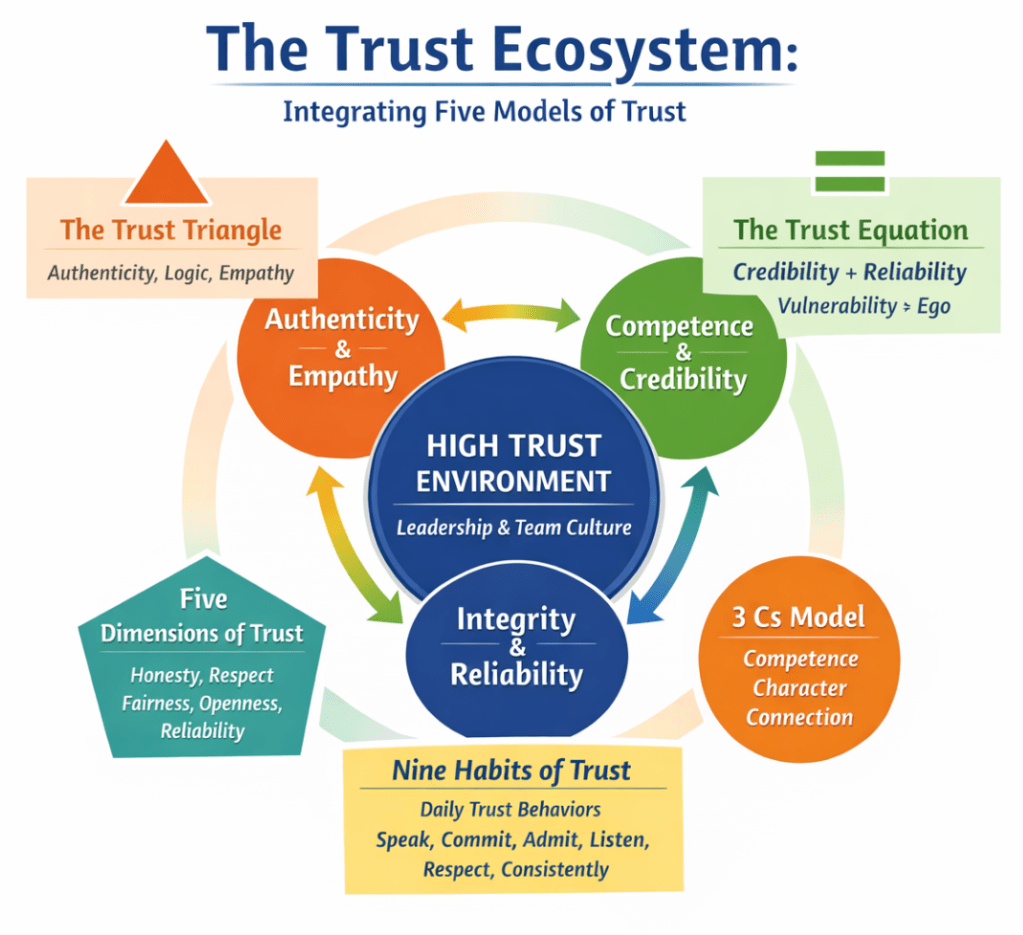
Trust is one of the most critical assets a leader can cultivate. Yet it is often discussed as if it were a single trait—something you either have or don’t. In reality, trust is complex, multidimensional, and observable. Over decades of leadership research, five models have emerged that describe how trust is built, maintained, and strengthened:
- The Trust Triangle – Authenticity, Logic, Empathy
- The Trust Equation – Credibility, Reliability, Vulnerability, Ego
- The Five Dimensions of Trust – Honesty, Respect, Fairness, Openness, Reliability
- The 3 Cs Model – Competence, Character, Connection
- The Nine Habits of Trust – Daily behaviors that signal reliability and care
Each model offers a unique perspective, yet together they form a coherent ecosystem that can guide leaders to develop trust systematically.
Why trust requires a multi-lens approach
Trust is not a single action, a personality trait, or a feeling. It is the cumulative result of patterns—patterns of behavior, integrity, and relational connection. One model may highlight leader behavior (Nine Habits), another the relational environment (Five Dimensions), and another the cognitive and emotional balance of decision-making (Trust Triangle). Using these models together provides both diagnostic clarity and practical guidance.
Comparing the models
| Model | Core components | Focus | Unique contribution | Practical takeaways |
|---|---|---|---|---|
| Trust Triangle | Authenticity, Logic, Empathy | Personal alignment, rationality, relational awareness | Shows trust requires simultaneous balance of being real, rational, and relational | Reflect daily: Are my words and actions authentic, logical, empathetic? Communicate decisions considering all three? |
| Trust Equation | Credibility + Reliability + Vulnerability ÷ Ego | Behavioral formula for trust | Quantifies trust and highlights the trust-eroding effect of ego | Build credibility with honesty, reliability with follow-through, vulnerability with admitted mistakes; reduce ego by centering mission over self-image |
| Five Dimensions of Trust | Honesty, Respect, Fairness, Openness, Reliability | Organizational culture and relational environment | Shifts focus from personality to trust as a collective experience | Establish transparent processes, communicate openly, apply standards fairly, maintain dignity, follow through consistently |
| 3 Cs Model | Competence, Character, Connection | Integration of performance, ethics, and relationships | Explains why competence alone does not guarantee trust | Develop skills continuously, act ethically, build meaningful relationships |
| Nine Habits of Trust | Speak the truth, Keep commitments, Admit mistakes, Communicate clearly, Respect, Empathy, Consistency, Fairness, Seek feedback | Daily, observable actions | Shows trust grows from repeated, practical behaviors | Track micro-actions, reflect, model habits consistently, embed trust practices into culture |
Key themes across models
Although each model emphasizes different aspects of trust, several common themes emerge:
- Trust is multidimensional – competence, integrity, and relationships all matter. No single factor is sufficient.
- Trust is observable and repeatable – patterns of behavior, not intentions, build confidence.
- Ego undermines trust – self-centered behavior can erode trust faster than lack of skill.
- Culture shapes trust – organizational norms determine whether trust flourishes or withers.
- Daily practice compounds – small actions, repeated consistently, produce durable trust.
By applying these principles, leaders move beyond vague aspirations and create a trust ecosystem: a structured, observable, and repeatable system of behaviors and values that reinforce each other.
Practical leadership applications
1. Self-Assessment
Use the combined insights of all five models to reflect regularly:
- Am I being authentic, logical, and empathetic in my interactions? (Trust Triangle)
- Are my credibility, reliability, and vulnerability strong while ego remains in check? (Trust Equation)
- Do my actions reflect honesty, respect, fairness, openness, and reliability? (Five Dimensions)
- Am I demonstrating competence, character, and connection consistently? (3 Cs)
- Am I practicing the Nine Habits daily, even in small interactions?
This multi-dimensional reflection ensures that leaders do not focus on one “easy” aspect of trust while neglecting others.
2. Communication Framework
Before communicating decisions or feedback, check:
- Authenticity: Are my words aligned with my values?
- Logic: Can I explain reasoning and trade-offs clearly?
- Empathy: Have I considered how others will experience this?
- Credibility: Is the information accurate and truthful?
- Vulnerability: Can I admit what I do not know or where I erred?
A single well-structured message can reinforce trust across multiple models simultaneously.
3. Behavioral Calibration
Leaders should identify trust leaks—patterns that diminish confidence—and address them through targeted actions:
- Missed commitments → strengthen reliability
- Unexplained decisions → increase clarity and logic
- Disconnected relationships → build connection and empathy
- High ego → practice humility and mission-focus
Small, intentional corrections compound over time and create a high-trust environment.
4. Team Culture
Trust is not only about individual leaders. By sharing these models with teams, leaders can cultivate collective responsibility for trust. Practices include:
- Embedding honesty, fairness, and respect in team norms
- Recognizing and rewarding trust-building behaviors
- Encouraging feedback loops that promote openness and vulnerability
- Modeling consistent application of daily habits
A team that practices trust collectively achieves higher resilience, engagement, and performance.
The trust ecosystem in action
Think of trust as a structure:
- Authenticity, Competence, and Credibility form the foundation.
- Empathy, Respect, and Connection are the beams that hold it upright.
- Reliability, Fairness, and Daily Habits are the reinforcements that make it durable.
When any component is weak, trust wobbles. When all elements are strong and aligned, trust becomes a platform for high performance, innovation, and collaboration. Leaders no longer need to micromanage behavior—they create an environment where trust flows naturally.
Conclusion
No single model fully captures the complexity of trust, but together they provide a comprehensive roadmap:
- Trust Triangle: Align your authenticity, logic, and empathy
- Trust Equation: Balance credibility, reliability, vulnerability, and ego
- Five Dimensions: Create a culture of honesty, respect, fairness, openness, and reliability
- 3 Cs Model: Integrate competence, character, and connection
- Nine Habits: Practice observable, repeatable behaviors daily
By understanding trust as a multi-layered ecosystem, leaders move from abstract intentions to concrete, repeatable actions. The result is not only stronger relationships but a high-performing organization where energy is devoted to solving problems, innovating, and achieving results—not guarding egos or second-guessing motives.
Trust, ultimately, is a deliberate, observable, and trainable discipline. Leaders who master it create teams and cultures that are resilient, motivated, and unstoppable.
 DREIESKIVA|Roald Kvam
Legg igjen en kommentar