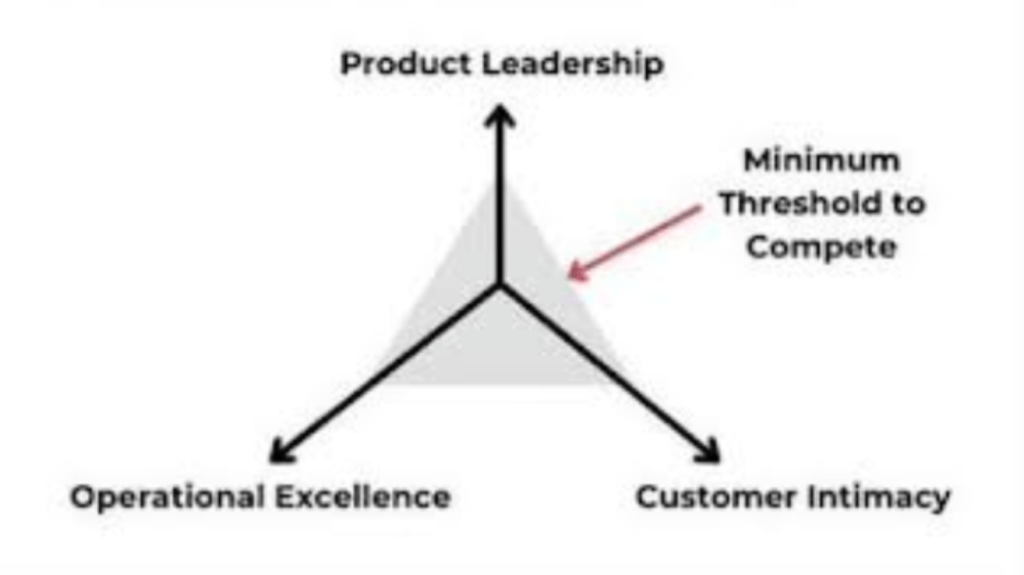
The quest for a sustainable competitive advantage has never been more challenging. Organizations often fall into the trap of trying to be everything to everyone, ultimately resulting in a diluted brand and mediocre performance. To survive and thrive, a company must choose a specific path to leadership. This strategic imperative is best captured in the Value Disciplines model, a framework that suggests companies can outperform rivals by excelling in one of three distinct areas while maintaining a «minimum threshold» in the others.
By aligning the Value Disciplines model with a robust Sales Strategy Framework, organizations can bridge the gap between high-level strategy and daily market execution, ensuring that their chosen discipline is felt by every customer they encounter.
The core philosophy of Value Disciplines
The Value Disciplines model identifies three primary paths to market leadership: Operational Excellence, Product Leadership, and Customer Intimacy. The fundamental premise is that no company can be the best at all three simultaneously, as each requires a different set of internal processes, cultural mindsets, and organizational structures.
1. Operational Excellence: Efficiency as a Competitive Weapon
Operational Excellence is defined by delivering products or services faster, cheaper, and with minimal hassle. Companies pursuing this discipline, such as Walmart or Amazon, prioritize lean processes, supply chain optimization, and rigorous cost control.
From a Sales Execution perspective, an operationally excellent firm relies on:
- Repeatable prospecting steps to ensure a high volume of leads is processed efficiently.
- Effective tools like CRM systems and automated sequences to minimize manual friction in the buyer journey.
- Measurable KPIs that focus on conversion speed and cost-per-acquisition.
The goal is to provide a «hassle-free» experience where the sales approach fits how the customer buys—specifically, customers who prioritize price and convenience.
2. Product Leadership: The Innovation Engine
Product Leadership involves offering products that push the performance boundary. Firms like Apple or Tesla do not compete on price; they compete on being the first to market with cutting-edge technology and superior design.
To support this discipline, the Value Delivery component of the sales strategy must be impeccable:
- The company must offer a clear ROI proposition based on the product’s advanced capabilities.
- Sales teams must focus on competitive differentiation, proving why their «frontier» product is superior to existing alternatives.
- The product must solve an urgent business problem that cannot be addressed by conventional solutions.
In this discipline, Market Fit is achieved when the product matches a customer need for innovation, and the sales team serves as consultants rather than mere order-takers.
3. Customer Intimacy: The Power of Personalization
Customer Intimacy focuses on tailoring and shaping products and services to fit an increasingly fine definition of the customer. This is not about one-size-fits-all efficiency, but about deep relationship building and long-term lifetime value.
The Market Approach for a customer-intimate firm is highly specialized:
- It requires decision-makers to be mapped at a granular level to understand personal and professional motivations.
- Success depends on identifying clear pain points that are unique to each specific account.
- The right timing for outreach is determined by the customer’s internal business cycles, not the seller’s quarterly targets.
When a firm achieves Sales Alignment in this discipline, the sales team understands the market and the pitch aligns perfectly with the buyer’s needs.
The strategic balance: The minimum threshold to compete
A common misconception is that a company can ignore the disciplines it does not choose. However, the model includes a «Minimum Threshold to Compete». If a Product Leader’s operations are so inefficient that they cannot ship their innovations, or if an Operationally Excellent firm’s product becomes obsolete, they will fail regardless of their primary strength.
Strategic dominance occurs in the «Sweet Spot» where the chosen discipline is supported by a synchronized sales engine:
- Scalable sales success: The organization has a repeatable way to win within its chosen discipline.
- Right customer: The firm targets segments that value its specific discipline (e.g., price-sensitive buyers for Operational Excellence).
- Right process: Internal workflows are optimized to deliver on the brand’s promise.
Aligning sales strategy with Value Disciplines
To turn a value discipline from a PowerPoint slide into a market reality, the Sales Strategy Framework must be utilized to create Market Fit.
Creating Market Fit
Market Fit is the intersection of Value Delivery and Sales Execution. For a company to succeed, the product must match the customer need, and the sales approach must fit how they buy.
- For Customer Intimacy, this means a strong discovery process to uncover deep-seated needs.
- For Product Leadership, it means being easy to demonstrate value through high-quality demos and technical proof-of-concepts.
- For Operational Excellence, it means an alignment with the buyer journey that is seamless and digital.
Achieving Sales Alignment
Sales Alignment happens when the Market Approach meets Sales Execution. It ensures the sales team understands the market and that the pitch aligns with buyer needs.
- Proven buyer interest signals allow teams to act quickly, a trait essential for operational leaders.
- Defined market segments ensure that intimate firms are not wasting time on customers who only care about the lowest price.
Conclusion: The path to the sweet spot
The Value Disciplines model provides the «North Star» for an organization, but the Sales Strategy Framework provides the «Engine».
Companies that find the Sweet Spot are those that have made a hard choice. They have decided whether they will lead through the efficiency of Operational Excellence, the innovation of Product Leadership, or the deep bonds of Customer Intimacy. Once that choice is made, they align their Market Approach, Value Delivery, and Sales Execution to deliver that specific promise every single day.
In the final analysis, strategic failure is often the result of «strategic straddling»—trying to do too much and succeeding at nothing. By committing to a single value discipline and building a measurable, repeatable sales process around it, organizations can cross the threshold of mere competition and enter the realm of true market dominance.
 DREIESKIVA|Roald Kvam
Legg igjen en kommentar