The ability to make fast and accurate decisions has become one of the most valuable human and organizational capabilities. Markets shift overnight, customer expectations evolve rapidly, and leaders are routinely required to act with incomplete information. In such environments, traditional linear decision-making models often prove too slow or rigid.
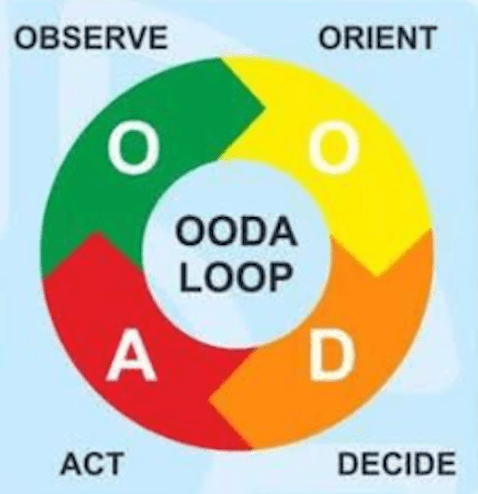
One framework that has stood the test of time in high-pressure environments is the OODA Loop: A decision-making model originally developed by military strategist and fighter pilot John Boyd. The OODA Loop stands for Observe, Orient, Decide, and Act, and it offers a dynamic, continuous cycle for understanding situations, forming judgments, and taking action.
Although rooted in military aviation, the OODA Loop has found widespread application in business, healthcare, sports, crisis management, and personal development. Its strength lies in its simplicity, adaptability, and emphasis on learning.
This article explores what the OODA Loop is, how each stage works, and how individuals and organizations can apply it to improve both the speed and quality of their decisions.
Understanding the OODA Loop
At its core, the OODA Loop describes how humans process information and turn it into action. Rather than seeing decision-making as a one-time event, Boyd conceptualized it as a continuous feedback-driven cycle:
- Observe
- Orient
- Decide
- Act
Once an action is taken, its results feed back into new observations, and the cycle begins again. The faster and more effectively you can move through this loop—while maintaining accuracy—the greater your advantage in any competitive or uncertain environment.
Importantly, the OODA Loop is not just about speed. It is about speed with understanding. Rushing through decisions without proper orientation often leads to costly mistakes. The power of the model lies in balancing tempo and insight.
Observe: Building situational awareness
The Observe stage is about gathering information. This includes:
- What is happening around you
- What has changed since last time
- What signals, patterns, or anomalies are visible
Observation draws from both external and internal sources. External inputs may include market data, customer feedback, competitor actions, and environmental conditions. Internal inputs may include performance metrics, team morale, resource availability, and personal stress levels.
Effective observation is not passive. It requires intentional scanning and filtering. Not all information is equally relevant, and noise can easily overwhelm signal.
Key practices in the Observe phase include:
- Monitoring key indicators regularly
- Seeking diverse information sources
- Noticing trends, not just events
- Questioning assumptions about what is “normal”
Strong observation creates the raw material for sound judgment. Weak observation leads to blind spots that no amount of clever analysis can fix.
Orient: Making sense of what you see
Orient is the most complex and influential stage of the loop. It is where raw data becomes meaning.
In this phase, you:
- Interpret observations
- Place them in context
- Compare them with experience, values, culture, and mental models
Orientation is shaped by many factors: education, training, previous successes and failures, organizational culture, biases, and worldview. Two people can observe the same situation and orient themselves in completely different ways.
Because of this, the Orient phase largely determines decision quality.
High-quality orientation involves:
- Challenging existing assumptions
- Considering multiple perspectives
- Identifying patterns and causal relationships
- Distinguishing between symptoms and root causes
For organizations, this means creating spaces where interpretation can be discussed openly. If only one viewpoint dominates, orientation becomes narrow and fragile.
A useful question in this stage is:
“What is really going on here?”
Decide: Choosing a course of action
Once you have oriented yourself, you must choose what to do.
Decide does not mean finding the perfect solution. In fast-moving environments, perfection is often impossible. Instead, it means selecting the best available option given current understanding.
Good decision-making at this stage is:
- Clear
- Timely
- Proportional to the risk
Overanalyzing small decisions wastes time. Underthinking high-impact decisions creates danger.
Effective decision-makers:
- Identify a small number of viable options
- Evaluate risks and upside quickly
- Commit to a direction
A crucial insight of the OODA Loop is that reversibility matters. If a decision can easily be changed, speed should be prioritized. If it is hard to reverse, more deliberate thinking is warranted.
Act: Turning decisions into reality
Decisions only create value when translated into action.
The Act phase involves:
- Executing the chosen course
- Communicating clearly
- Coordinating resources
- Monitoring immediate effects
Speed of execution is important, but so is alignment. Confusion or half-hearted implementation can undermine even the best decision.
Once action is taken, results—both intended and unintended—flow back into observation. The loop continues.
In mature organizations, action is accompanied by lightweight feedback mechanisms: short reviews, quick metrics, and open dialogue.
Why the OODA Loop works
The OODA Loop succeeds because it mirrors how reality actually behaves:
- Conditions change continuously
- Information is incomplete
- Learning never stops
Instead of assuming stability, the model assumes motion.
Three key advantages stand out:
- Adaptability
You are never locked into a single plan. Each cycle allows adjustment. - Learning Orientation
Every loop improves understanding. - Competitive Advantage
Those who learn and adapt faster outperform those who move slowly or rigidly.
In business, this means organizations that iterate quickly will outpace those waiting for perfect data.
Using the OODA Loop effectively
To get real value from the OODA Loop, it must become a habit, not a slogan.
1. Be agile
Treat plans as hypotheses, not guarantees. Expect to update them.
2. Avoid analysis paralysis
Gather enough information to act responsibly—but not so much that momentum dies.
3. Continuously learn
After actions, ask: What worked? What didn’t? Why?
4. Build fast feedback loops
Short cycles produce faster improvement.
5. Empower decision-making
Push authority closer to where information originates.
Applying the OODA Loop in organizations
At the organizational level, the OODA Loop becomes a cultural pattern.
- Leadership observes market signals
- Teams orient through shared sensemaking
- Decisions are made at appropriate levels
- Actions are reviewed quickly
High-performing organizations often display:
- Transparent information flow
- Psychological safety for speaking up
- Rapid experimentation
- Tolerance for intelligent failure
Importantly, organizations should avoid turning the OODA Loop into bureaucracy. Heavy templates and excessive documentation slow the loop. The model thrives in lightweight structures.
OODA Loop in leadership
For leaders, the OODA Loop is both an external and internal tool.
Externally, it guides strategic choices.
Internally, it helps leaders manage their own reactions.
Before responding emotionally to a difficult situation, a leader can mentally run a quick loop:
- What am I observing?
- How am I interpreting this?
- What options exist?
- What is the most constructive action?
This pause often prevents reactive behavior and improves judgment.
OODA Loop vs. traditional planning
Traditional planning often assumes:
- Stable conditions
- Predictable outcomes
- Long cycles
The OODA Loop assumes:
- Change
- Uncertainty
- Continuous adaptation
This does not mean abandoning planning. It means treating plans as living guides, constantly adjusted through looping.
The human element
Perhaps the most profound insight of the OODA Loop is that decision-making is not purely rational. Orientation is deeply human. It is shaped by identity, emotion, and experience.
Improving decisions, therefore, is not only about better data. It is about:
- Better self-awareness
- Better dialogue
- Better learning cultures
Organizations that invest in these human capabilities strengthen the very heart of their decision loops.
— —
The OODA Loop offers a powerful yet simple way to navigate complexity. By continuously cycling through Observe, Orient, Decide, and Act, individuals and organizations develop a rhythm of learning and action that keeps them responsive and resilient.
Fast and accurate decision-making is not a talent reserved for a few. It is a skill that can be practiced, refined, and embedded into daily work.
In a world where change is constant, the greatest advantage is not predicting the future—it is adapting faster than it unfolds.
 DREIESKIVA|Roald Kvam
Legg igjen en kommentar