Strategy is one of the most used—and most misunderstood—words in leadership. Many organizations claim to have a strategy, yet struggle to explain how their daily decisions connect to winning in the marketplace. Too often, strategy becomes confused with vision, planning, goal-setting, or operational efficiency. The result is organizations that are busy, well-intentioned, and disciplined—yet not strategically distinctive.
The Playing to Win framework, developed by A.G. Lafley and Roger L. Martin, cuts through this confusion with a simple but demanding idea: strategy is a coordinated and integrated set of choices that positions an organization to win. Not to participate. Not to survive. But to win—according to a clearly defined aspiration.
At its core, Playing to Win reframes strategy from abstract ambition to disciplined decision-making. It insists that leaders confront hard trade-offs, make explicit choices, and align the organization around them.
What strategy is—and what it is not
Strategy is about making specific choices to win in the marketplace.
It requires deliberately choosing a different set of activities than competitors, creating a unique position that delivers superior value. Strategy is not about doing everything well. It is about choosing what not to do as much as choosing what to do.
This definition challenges several common misconceptions about strategy:
- Strategy is not a vision statement
- Strategy is not a long-term plan
- Strategy is not a list of goals
- Strategy is not operational excellence or best practices
Vision describes aspiration. Plans describe execution. Goals describe outcomes. Best practices describe efficiency. Strategy, by contrast, describes how you intend to win—given the realities of competition, customers, capabilities, and constraints.
An organization can have a compelling vision, ambitious goals, and excellent execution—and still lack a strategy.
The strategic choice cascade
The heart of the Playing to Win framework is the Strategic Choice Cascade: five interdependent choices that must be made explicitly and coherently. These choices form a logical flow, where each decision informs and constrains the next.
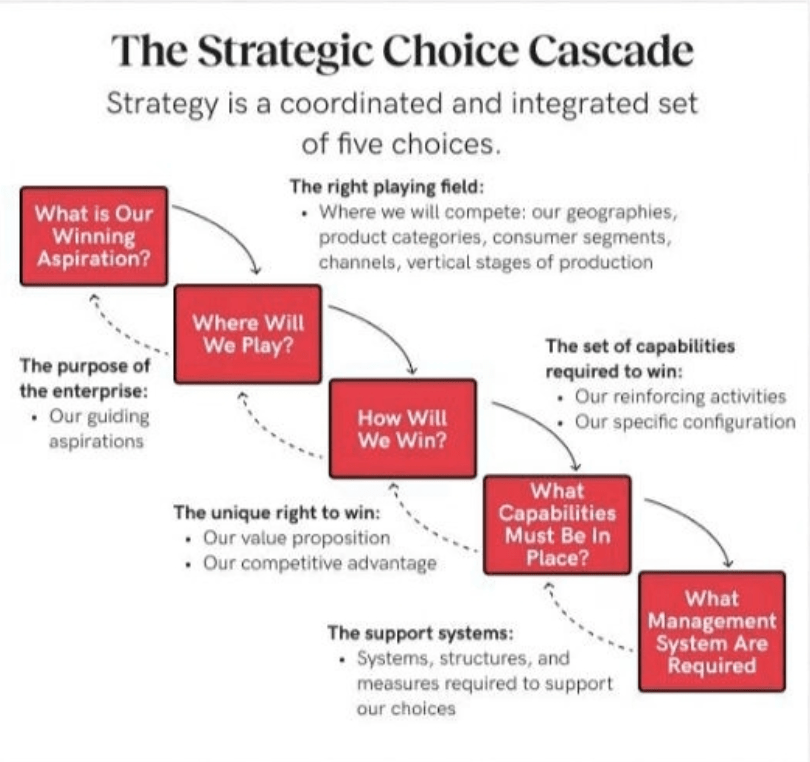
1. What Is Our Winning Aspiration?
Every strategy begins with a clear answer to the question: What does winning mean for us?
Winning is not the same for every organization. For some, it may mean market leadership. For others, sustainable profitability, category creation, social impact, or long-term relevance. The key is that winning must be explicit, shared, and meaningful.
A winning aspiration defines purpose and ambition. It sets the tone for all subsequent choices. Without it, strategy becomes directionless optimization.
Importantly, a winning aspiration is not a vague desire to “be the best” or “grow faster.” It is a concrete expression of what success looks like—on your own terms.
2. Where Will We Play?
Once the aspiration is clear, leaders must decide where the organization will compete. This is one of the most critical—and most avoided—strategic decisions.
Where to play includes choices about:
- Markets and geographies
- Customer segments
- Product categories
- Distribution channels
- Stages of the value chain
These are not neutral decisions. Every choice to play somewhere is also a choice not to play elsewhere.
Organizations that fail to make clear “where to play” choices often spread themselves too thin, chasing opportunities without coherence. Focus is not a constraint—it is a strategic advantage.
3. How Will We Win?
If “where to play” defines the battlefield, “how to win” defines the approach to victory.
This choice answers the question: What is our unique value proposition in the places we choose to play?
Winning can come from many sources:
- Superior customer experience
- Lower cost structure
- Differentiated features or design
- Brand trust and loyalty
- Speed, convenience, or customization
The critical point is that the “how” must be distinctive and defensible. Competing on everything leads to advantage in nothing.
“How will we win?” forces leaders to articulate why customers will choose them over alternatives—and why that advantage can be sustained.
4. What Capabilities Must Be in Place?
Strategy is not just about external positioning; it is equally about internal readiness.
Once leaders define how they intend to win, they must ask: What capabilities do we need to deliver on this promise—consistently and better than others?
Capabilities are not individual skills. They are integrated systems of people, processes, technologies, and culture. Examples include:
- Deep customer insight and analytics
- World-class supply chain execution
- Rapid innovation and iteration
- Relationship-based sales excellence
- Scalable digital platforms
Crucially, organizations cannot excel at everything. Strategic capability building requires prioritization and investment. The goal is not competence across the board, but excellence where it matters most.
5. What Management Systems Are Required?
Finally, strategy must be sustained through management systems—the structures, incentives, metrics, and processes that reinforce strategic choices.
This includes:
- Performance measurement and KPIs
- Resource allocation and budgeting
- Decision rights and governance
- Talent development and incentives
Without aligned management systems, even the best strategy will erode over time. What gets measured, rewarded, and discussed ultimately shapes behavior.
Strategy is not what leaders say—it is what the organization consistently does.
Strategy as a logical flow, not a checklist
One of the strengths of the Playing to Win framework is its emphasis on logical coherence. The five choices are not independent. They form a chain of cause and effect.
A change in one choice requires reconsideration of the others. For example:
- A new market may demand new capabilities
- A different winning approach may require new systems
- A revised aspiration may shift where to play
This coherence is what differentiates strategy from a collection of initiatives. Strategy is about fit—between choices, capabilities, and systems.
Avoiding ineffective approaches to strategy
The framework also highlights common but ineffective ways organizations approach strategy, including:
- Treating strategy as a vision statement
- Confusing strategy with annual planning
- Denying that long-term strategy is possible
- Focusing solely on incremental optimization
- Blindly following best practices
These approaches avoid the discomfort of choice. They prioritize consensus over clarity and activity over direction.
Playing to Win insists that real strategy requires courage—the courage to choose, to say no, and to accept risk.
Reverse engineering strategic choices
Another powerful element of the framework is reverse engineering: testing strategic choices by asking what must be true for them to succeed.
Instead of asking, “Is this strategy perfect?” leaders ask:
- What assumptions are we making?
- Which conditions must hold true?
- Which risks are most critical?
- What evidence would increase our confidence?
This approach encourages learning, experimentation, and disciplined adaptation—without abandoning strategic intent at the first sign of uncertainty.
Why this framework matters
The enduring value of Playing to Win lies in its clarity. It does not promise certainty or easy answers. Instead, it provides a structured way to engage in the hard work of strategy.
It helps leaders:
- Move from ambition to action
- Align organizations around clear choices
- Make trade-offs explicit rather than implicit
- Connect strategy to capabilities and systems
- Sustain advantage over time
In a world of rapid change, strategy is often mistaken for speed or flexibility. But speed without direction leads to exhaustion. Flexibility without coherence leads to drift.
Strategy, properly understood, is what allows organizations to adapt without losing themselves.
Choosing to win
Playing to Win reminds leaders of a simple but uncomfortable truth: there is no neutral strategy. Not choosing is still a choice—one that competitors will exploit.
Winning does not come from doing more things. It comes from doing the right things, in the right places, in a distinctive way, supported by capabilities and systems that reinforce those choices.
Strategy is not about predicting the future. It is about making thoughtful, courageous decisions in the present—decisions that shape the future you are willing to compete for.
In that sense, strategy is not just a business discipline. It is a leadership responsibility.
 DREIESKIVA|Roald Kvam
Legg igjen en kommentar