In the complex tapestry of human interaction—whether in high-stakes boardrooms, intimate personal relationships, or high-pressure customer service environments—difficult conversations are not exceptions; they are inevitable. These moments, characterized by high emotion, opposing views, or profound misunderstandings, serve as crucibles for our communication skills. Handled poorly, they can lead to irreparable damage, resentment, and failed objectives. Handled well, they transform into catalysts for deeper understanding, creative problem-solving, and strengthened relationships.
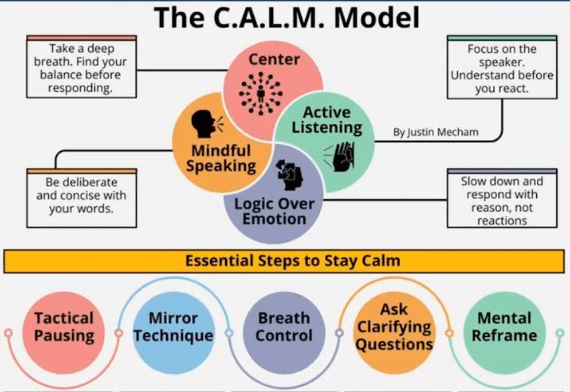
The challenge lies in the physiological response to conflict. When confronted or stressed, the brain’s amygdala triggers a «fight, flight, or freeze» response, hijacking the prefrontal cortex—the seat of rational thought and complex communication. Staying calm when it truly counts requires a deliberate, structured intervention. This is the foundation of The C.A.L.M. Model, a robust framework designed to anchor us in logic and presence when the natural impulse is to react emotionally. By systematically addressing the physiological, cognitive, and verbal components of a challenging interaction, the C.A.L.M. Model offers a pathway to composure and constructive dialogue, ensuring that even the toughest conversations yield progress, not pathology. This article will deconstruct The C.A.L.M. Model, its essential supporting techniques, and real-time application tips to help you master the art of staying centered under pressure.
Deconstructing the C.A.L.M. model
The acronym C.A.L.M. provides a four-step sequence for internal and external regulation during high-stress dialogue, guiding the speaker from physiological grounding to mindful verbal delivery.
C: Center – Find Your Balance Before Responding
The first step in the C.A.L.M. process is purely internal and physiological. Centering requires a conscious pause to regulate the body’s stress response. This begins with a deep breath. When stress hormones surge, breathing becomes shallow and rapid, reinforcing the feeling of panic. A slow, diaphragmatic breath signals safety to the nervous system, immediately lowering the heart rate and allowing blood flow to return to the rational parts of the brain. The instruction to «find your balance» is a metaphor for grounding oneself—acknowledging the tension without being consumed by it. This pause creates crucial cognitive space between the stimulus (what the other person said) and your response, preventing the instantaneous, regrettable emotional reaction. Without centering, the subsequent steps of the model are almost impossible to execute effectively.
A: Active Listening – Understand Before You React
Active Listening is arguably the most powerful yet underutilized tool in conflict resolution. The model emphasizes: Focus on the speaker. Understand before you react. When we feel defensive, our brains typically allocate 80% of their energy to formulating a rebuttal and 20% to listening. Active Listening flips this ratio. It means listening not just to the words, but to the emotion, the tone, and the underlying needs the speaker is expressing. This practice requires intentional non-verbal cues—maintaining eye contact, nodding, and avoiding interruptions—to signal genuine engagement. Critically, Active Listening is a temporary suspension of one’s own agenda. By seeking full clarity through techniques like paraphrasing and summarizing (a core supporting step), you de-escalate the tension. People often become less aggressive when they feel truly heard, creating an opening for a rational response.
L: Logic Over Emotion – Respond with Reason, Not Reactions
The core of emotional intelligence in conflict lies in the ability to prioritize logic. Logic Over Emotion means consciously slowing down the internal processing speed to engage the prefrontal cortex. Reactions are instantaneous, defensive, and often escalate conflict. Responses are deliberate, goal-oriented, and constructive. This is a moment of internal negotiation: instead of saying the first sharp, satisfying thought that comes to mind, you ask, «What is the most constructive thing I can say right now to achieve my objective?» This step is supported by the Emotional Reset and Anchor Words tips (discussed in Part III), which function as mental guardrails to keep the conversation on a productive track. Prioritizing logic moves the conversation from a destructive battle of wills to a cooperative exercise in problem-solving.
M: Mindful Speaking – Be Deliberate and Concise with Your Words
Following the internal work of centering, listening, and rationalizing, the final step dictates the external delivery. Mindful Speaking involves being «deliberate and concise.» In difficult conversations, less is often more. Verbosity can be misinterpreted as defensiveness or rambling, confusing the core message. Deliberate language ensures every word serves a purpose. It means choosing neutral, non-judgmental language, focusing on «I» statements rather than accusatory «you» statements, and addressing the specific issue at hand rather than bringing up past grievances. When you speak mindfully, you demonstrate control, credibility, and respect, making your message exponentially more impactful and harder to dismiss.
Essential steps for maintaining composure and connection
The C.A.L.M. Model is supported by five essential techniques that provide both internal grounding and external rapport-building capabilities.
1. Tactical Pausing
Tactical Pausing is the conscious, strategic use of silence. The instruction is to «use pauses to gather thoughts and avoid impulsive reactions.» The psychological benefit of a pause is threefold: it interrupts the internal fight-or-flight cycle, it allows time for the Mindful Speaking step, and externally, it signals to the other party that you are taking their input seriously enough to consider it fully. While silence can feel uncomfortable, it often forces the other person to fill the void, potentially revealing more information or tempering their own emotional intensity.
2. Mirror Technique
The Mirror Technique is a subtle, advanced skill for building rapport. It involves reflecting the language and tone of the speaker to create rapport. This is not crude mimicking, but a gentle validation. If the speaker uses the word «unacceptable,» you might integrate that word into your clarifying question («So, the unacceptable part for you is X?»). If they speak with a quiet, measured tone, you match that tone rather than raising your voice. This subconscious echoing makes the speaker feel understood and connected, reducing the perception of antagonism and allowing both parties to feel more psychologically safe.
3. Breath Control
While tied to the «Center» step, Breath Control is a continuous, real-time maintenance strategy. The goal is to slow your breathing to reduce tension and increase clarity of thought. Research on the Vagus nerve shows that slow, deep, rhythmic breathing is the fastest non-pharmacological way to activate the parasympathetic nervous system—the «rest and digest» mode. During a conversation, practicing a simple 4-second inhale, 6-second exhale pattern can be performed almost imperceptibly, serving as a constant anchor of calm.
4. Ask Clarifying Questions
This step directly supports Active Listening: Ensure you fully understand the context before responding. Asking questions like, «Just so I’m clear, are you saying X or Y?» or «Can you give me an example of when this happened?» is critical. Clarifying questions achieve two primary goals: they confirm that your understanding is correct (preventing miscommunication), and they force the speaker to shift from an emotional outburst to a cognitive explanation, which often acts as a de-escalation tool. By focusing on inquiry, you move the dialogue from confrontation to collaboration.
5. Mental Reframe
Mental Reframe is a powerful cognitive tool drawn from Cognitive Behavioral Therapy (CBT). It involves shifting your mindset: Think of conversations as opportunities, not threats. Our stress response often originates from the perception that the conversation threatens our ego, goals, or security. By mentally reframing the situation as an opportunity—to learn, to solve a complex issue, to set a necessary boundary, or to grow a relationship—you reduce the feeling of threat, which in turn reduces the need for a defensive emotional reaction. This is the ultimate internal shift from a reactive to a proactive stance.
Real-time conversation tips and advanced practice
Mastery of the C.A.L.M. model is achieved through the consistent application of small, real-time techniques that support internal regulation.
The Mind-Body Connection
- Controlled breathing: This moves the practice from the theoretical to the practical. Before, during a brief pause, and after the conversation, intentional breathing calms the nervous system. Practice makes perfect, ideally engaging in breathing exercises before entering the difficult dialogue.
- Active posture: The body informs the mind. Sitting or standing straight—shoulders back, feet planted, hands visible—conveys confidence and clarity, both to the external observer and, crucially, to your own internal state. A slouched or defensive posture (e.g., crossed arms) reinforces feelings of insecurity and antagonism.
Language and Pausing Tools
- Verbal cues: These are essential tactics to buy time for the «Center» and «Logic Over Emotion» steps. Using short phrases like, «That’s an important point. Let me think for a moment,» or «I need a second to process that,» legitimizes your pause and prepares the speaker for a thoughtful response rather than an immediate answer.
- Anchor words: An Anchor Word is a key word or phrase you repeat in your mind to maintain focus and clarity. This could be a personal mantra («stay present,» «calm,» «goal») or the objective of the conversation itself. When emotional noise becomes overwhelming, focusing on this anchor prevents your mind from spiraling into unproductive rumination or defensiveness.
The Internal Reset
- Emotional reset: This is the emergency brake for emotional flooding. If overwhelmed, silently repeating a phrase like, «This is temporary,» helps detach you from the intense feeling. It reminds your rational brain that the feeling is a state, not a permanent reality, allowing the emotional intensity to subside enough for logic to regain control.
The transformative power of C.A.L.M.
The C.A.L.M. Model—Center, Active Listening, Logic Over Emotion, Mindful Speaking—is more than just a mnemonic device; it is a holistic blueprint for conscious communication. It recognizes that effective dialogue in the face of conflict begins not with what we say, but with how we regulate ourselves internally. By integrating the essential steps like Tactical Pausing and Mental Reframe with real-time tips like Controlled Breathing and Anchor Words, you equip yourself to navigate the most turbulent conversational waters.
Mastering this model is a developmental journey. It requires sustained practice, self-awareness, and a willingness to resist the primal urge to retaliate. The reward, however, is profound: a transformative ability to stay calm, centered, and constructive in any conversation, leading to stronger relationships, clearer outcomes, and a fundamental shift in how you experience conflict—from a dreaded threat to a powerful opportunity for connection and growth.
 DREIESKIVA|Roald Kvam
Legg igjen en kommentar