The ADKAR model is a structured, goal-oriented approach used by organizations to manage and ensure the success of large-scale change initiatives. Developed by Prosci founder Jeff Hiatt, the model focuses on the five sequential building blocks—or outcomes—that an individual must achieve for organizational change to be successful.
The provided framework outlines the five phases of ADKAR and maps them onto a sample 12-week roadmap, dividing the overall process into an Enabling Zone and an Engagement Zone.
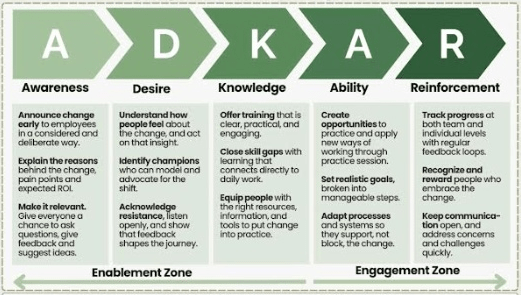
The five phases of ADKAR
The ADKAR acronym represents five sequential goals, each focusing on a specific outcome in the change process:
A: Awareness
This initial phase focuses on communicating the change. The objective is to ensure employees understand why the change is happening, the risks of not changing, and the expected impact of the new initiative. Key activities in this stage include announcing the change early, explaining the reasons, and making the change relevant to the individual. Providing employees with a forum to ask questions and offer feedback is also crucial here.
D: Desire
The Desire phase addresses the employee’s choice to support and participate in the change. This is a personal decision and cannot be mandated. Management must work to understand how people feel about the change, acknowledge potential resistance, and actively listen. Identifying champions who can model and advocate for the shift is a key deliverable in this phase, which helps cultivate a positive emotional environment.
K: Knowledge
Knowledge focuses on teaching employees the information and skills required for the change. This phase involves offering targeted training that is clear, practical, and directly connected to daily work. The organization must equip its people with the necessary resources, information, and tools. A key deliverable is creating a training calendar and a content library (guides, video, live sessions) tailored by role.
A: Ability
While Knowledge addresses theoretical understanding, Ability focuses on turning that knowledge into practical performance. This phase is about creating opportunities for employees to apply the new ways of working through practical application and coaching. Setting realistic goals and adapting processes to remove roadblocks are vital. Key activities include hosting simulations, role-practice sessions, and developing a coaching log and performance baseline report.
R: Reinforcement
The final stage ensures the change sticks. Reinforcement involves tracking progress at both team and individual levels using regular feedback loops. The organization must recognize and reward employees who embrace the change and establish mechanisms to keep communication open. A critical deliverable is the Adoption dashboard and the development of reinforcement frameworks to monitor long-term adherence and address any new challenges quickly.
The 12-week roadmap: Zones of omplementation
The framework suggests structuring the ADKAR process over approximately 12 weeks, dividing the work into two distinct phases:
1. Enabling Zone (Weeks 1-6)
This initial zone focuses on preparing the organization and individuals for the transition.
- Weeks 1-2 (Awareness): Activities center on mapping stakeholders, sharing the «why,» and holding key leadership Q&A sessions. Key deliverables include the communication plan and stakeholder map.
- Weeks 3-4 (Desire): The focus shifts to identifying champions, addressing resistance, and running feedback loops to address concerns. Key deliverables include the engagement plan and a clear risk log.
- Weeks 5-6 (Knowledge): This phase is dedicated to delivering tailored, bite-sized training and creating quick-reference tools to support the daily use of the new system or process.
2. Engagement Zone (Weeks 7-12)
This zone focuses on the practical application, measurement, and sustainment of the change.
- Weeks 7-8 (Ability): Activities mirror the Awareness phase but focus on application, including sharing visibility data (like performance baselines) and ensuring leadership remains transparent through Q&A. This is where coaching becomes paramount.
- Weeks 9-12 (Reinforcement): The final weeks are dedicated to monitoring progress, pairing staff with mentors or super-users, and measuring adoption gaps. Key deliverables include the Adoption framework, a recognition program, and reports detailing Return on Investment (ROI) snapshots.
By systematically addressing these five human factors—and using a structured roadmap to guide the process—the ADKAR model aims to maximize the likelihood that organizational changes are successfully adopted and sustained.
 DREIESKIVA|Roald Kvam
Legg igjen en kommentar