We can describe negative thoughts also called cognitions on four levels. These are 1) Core Beliefs, 2) Rigid Rules, 3) Conditional Assumptions and 4) Negative Automatic Thoughts.
These four layers of thinking influence how we view ourselves, the world and the future. This can lead to distressing feelings and unhelpful behaviours, if we act out or avoid situations based on unrealistic or negative perceptions.
Challenging and changing the content of our thoughts can profoundly shape the way we feel and behave. This is known as cognitive restructuring. Each of the four layers of thinking are outlined below.
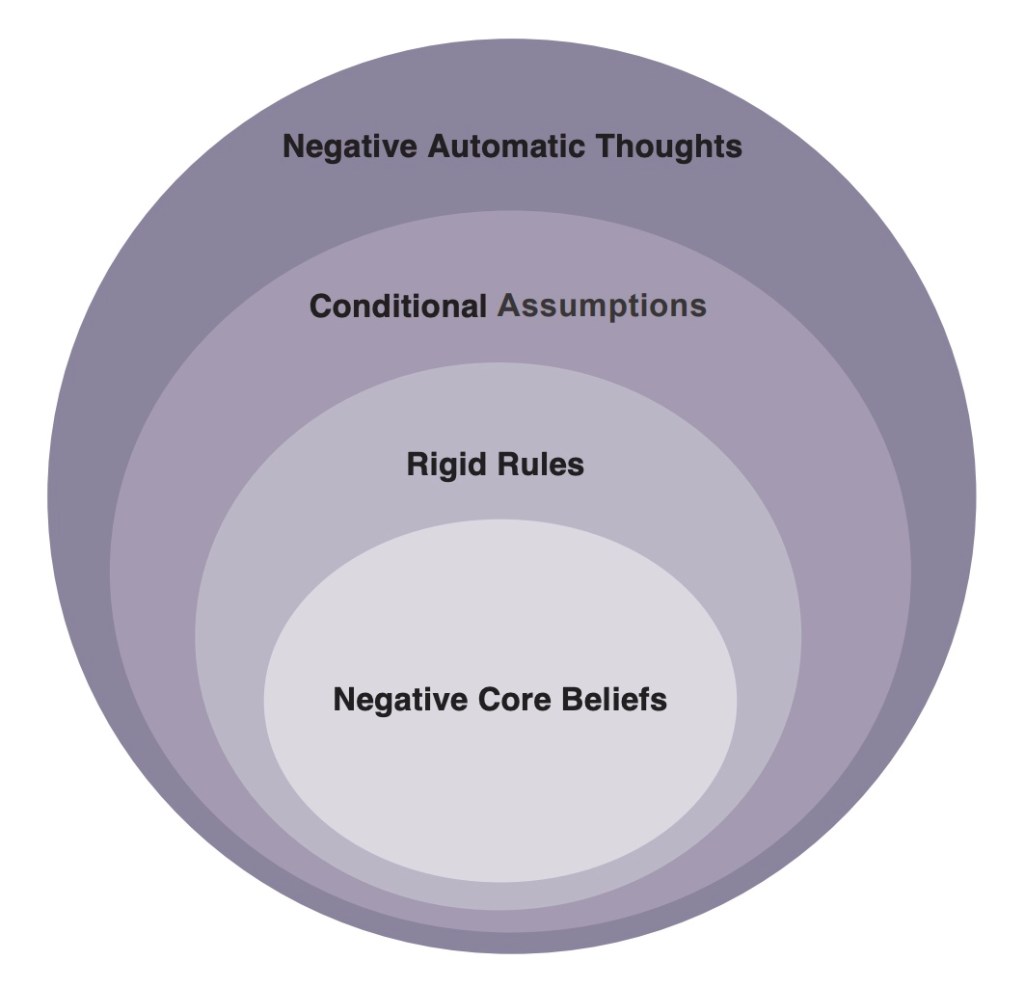
Negative automatic thoughts (NATS)
NATS are fleeting automatic thoughts that can be explicit or at the very edge of our conscious awareness. They form an internal monologue that can negatively influence how we automatically interpret situations, react and feel.
Some typical examples include:
- I can’t cope.
- They don’t like me.
- I am stupid.
- I always mess up.
- It’s not fair.
- I hate it.
Rigid rules
Rigid rules are irrational thinking principles that are automatically applied and rarely challenged in daily life. They are often expressed as “musts” and “shoulds” and usually based on inflexible expectations or demands. Rigid Irrational rules are often formed in childhood when following simple rules was important, however they can often provide rigid and unhelpful demands in later life.
Examples include:
- I must always work hard.
- People can’t be trusted.
- I should always be strong.
- There is no point trying.
- I will ultimately fail.
- I should not be anxious.
Conditional assumptions
Conditional assumptions are deeply rooted, dysfunctional and engrained thinking reflexes. They operate like knee-jerk reactions and are often expressed as conditional “if then” statements.
Examples include:
- If I am criticised, then I am no good.
- If I don’t deliver 100%, then it proves I am a failure.
- If I don’t get attention, I am unwanted or disliked.
- If I can’t think of something interesting to say, people will think I am boring.
- If I always work hard, I will be a success.
- If I am not in control, then something bad will happen.
Negative core beliefs
Negative core beliefs are fundamental, absolutist and generalised beliefs that we hold about ourselves, other people, the world and the future.
Negative core beliefs develop in response to early life experiences and can be divided into three categories covering helplessness, lovability and worthlessness.
Examples include:
- Helplessness Beliefs:
- I am vulnerable, weak, needy, a victim, likely to be hurt.
- I am stupid, ineffectual, incompetent, can’t cope.
- I am inferior, a failure, a loser, defective, not good enough.
- Unlovability Beliefs:
- I am unlikable, unwanted, will be rejected or abandoned,
always be alone. - I am undesirable, unattractive, boring, have nothing to offer.
- I am different, flawed, weird, not normal.
- I am unlikable, unwanted, will be rejected or abandoned,
- Worthlessness Beliefs:
- I am worthless, unacceptable, crazy, broken, nothing.
- I am dangerous, toxic, bad, evil,
- I deserve punishment, pain, suffering.
Compensatory strategies
Whilst compensatory strategies are not strictly cognitions, they form the link between our thoughts and the action or behaviours we take. These strategies basically tell us how to behave when our negative cognitions are activated. Compensatory strategies can be under-developed leading to patterns of avoidance, or over-developed, leading to strategies of control.
Examples include:
- Attend to the problem by worrying about it.
- Seek approval, ask for reassurance or people please.
- Continuously check or examine things to reduce uncertainty
- Procrastinate, avoid or withdraw.
- Over prepare / apply perfectionist standards.
- Blame criticise or attack.
 DREIESKIVA|Roald Kvam
Legg igjen en kommentar