In a world overflowing with complexity, fast-paced changes, and unpredictable variables, strategic clarity is more important than ever. One tool that has stood the test of time for helping individuals, teams, and organizations gain that clarity is the SWOT Analysis.
SWOT—an acronym for Strengths, Weaknesses, Opportunities, and Threats—is a strategic planning framework designed to help decision-makers understand internal and external factors that influence their goals. It’s simple, versatile, and highly effective, whether you’re launching a new product, reviewing business strategy, planning a career move, or assessing personal growth.
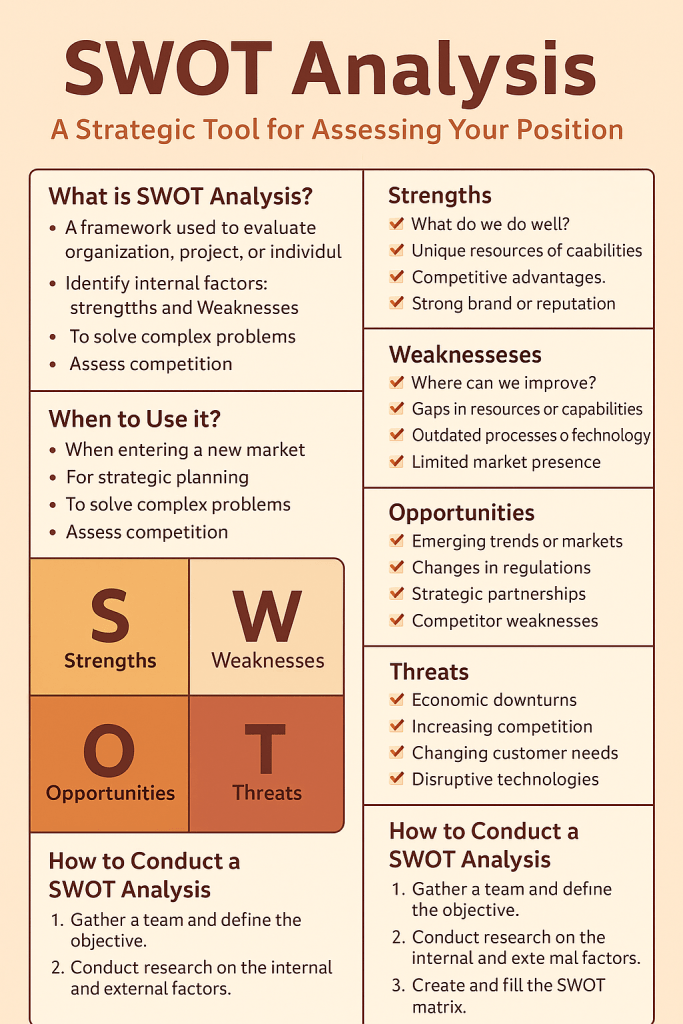
What is SWOT Analysis?
At its core, SWOT is a matrix-based framework that evaluates internal strengths and weaknesses, alongside external opportunities and threats.
| Internal Factors | External Factors |
|---|---|
| Strengths (S) | Opportunities (O) |
Weaknesses  | Threats (T) |
By organizing information into these four categories, SWOT helps individuals or organizations make more informed decisions.
Understanding the four elements
1. Strengths
Strengths are the internal capabilities and resources that give an advantage.
Questions to ask:
- What do we do better than others?
- What unique resources do we possess?
- What positive attributes do we have?
Examples:
- Strong brand reputation
- Talented and experienced staff
- Efficient processes
- Loyal customer base
2. Weaknesses
Weaknesses are internal limitations that could hinder success.
Questions to ask:
- Where do we lack resources or capabilities?
- What complaints or recurring issues exist?
- What could we improve?
Examples:
- High employee turnover
- Outdated technology
- Poor online presence
- Limited product range
3. Opportunities
Opportunities are external conditions that could be exploited for growth or advantage.
Questions to ask:
- What market trends can we capitalize on?
- Are there emerging needs we can fulfill?
- What changes in regulation or technology benefit us?
Examples:
- Market expansion into a new region
- Technological innovations
- Partnerships or acquisitions
- Untapped customer segments
4. Threats
Threats are external elements that could pose risks or harm to performance.
Questions to ask:
- What obstacles do we face?
- Are competitors growing stronger?
- Could economic or political shifts affect us?
Examples:
- New market entrants
- Changing customer preferences
- Regulatory challenges
- Economic downturn
How to conduct a SWOT Analysis
- Set the objective Clearly define what you’re analyzing—a project, organization, or personal goal.
- Gather data Use internal data, market research, and stakeholder feedback.
- Brainstorm ideas Collaborate with teams or advisors to fill in each quadrant.
- Organize and prioritize Group similar ideas and highlight the most significant factors.
- Develop a strategy Use SWOT findings to formulate actionable plans.
SWOT in action: A startup example
Let’s say a tech startup is analyzing its position before launching a new app.
Strengths:
- Agile development team
- User-centric design
- Strong investor backing
Weaknesses:
- Limited marketing budget
- Small customer base
Opportunities:
- Growing demand for remote collaboration tools
- Positive industry trends post-pandemic
Threats:
- Well-funded competitors
- Fast-changing technology
Strategic move: Focus on niche markets and collaborate with influencers to overcome marketing limitations.
Benefits of SWOT Analysis
| Benefit | Description |
| Simple and Intuitive | Easy to learn and use across all levels |
| Holistic View | Combines internal and external perspectives |
| Versatile | Works for organizations, teams, and individuals |
| Strategic Focus | Encourages informed planning and prioritization |
| Risk Awareness | Highlights challenges and prepares for them |
When to use SWOT Analysis
- Business planning and strategy formulation
- New product or service launches
- Market entry or expansion decisions
- Career or life planning
- Organizational assessments or audits
SWOT vs. 0ther Tools
| Tool | Focus | Comparison to SWOT |
| PESTLE | Macro-environmental factors | Broader than SWOT, focuses on external only |
| Porter’s 5 Forces | Industry competition | More complex and specific to competitive strategy |
| Value Chain | Internal operations | Complements SWOT with more detail on internal functions |
SWOT remains a foundational tool because it’s adaptable and requires no specialized software or data analytics tools to begin.
Best Practices for effective SWOT
- Be honest and realistic: Don’t inflate strengths or downplay weaknesses.
- Involve multiple voices: Get perspectives from different stakeholders.
- Stay relevant: Keep the analysis aligned with your objective.
- Make it actionable: Turn insights into priorities and next steps.
- Review regularly: Use SWOT as a living tool, not a one-time exercise.
From insight to action: Using TOWS Matrix
Once SWOT is complete, transform insights into action using a TOWS Matrix—a variation that helps strategize by matching internal factors with external ones.
| Strategy Type | Example Approach |
| S-O | Use strengths to seize opportunities |
| W-O | Improve weaknesses to exploit opportunities |
| S-T | Use strengths to mitigate threats |
| W-T | Minimize weaknesses and avoid threats |
This allows you to convert abstract analysis into practical strategy.
Final thoughts: SWOT as a compass
In a world where strategy can often feel like navigating a storm, SWOT provides a clear compass. It doesn’t require expensive tools or long reports—just thoughtful reflection, open discussion, and a willingness to act.
Whether you’re a CEO shaping a company’s direction or an individual mapping out a new chapter in life, SWOT is a powerful ally. It helps you anchor in what’s working, face what’s not, recognize new potential, and prepare for the unexpected.
And in that clarity, real progress begins.
 DREIESKIVA|Roald Kvam
Legg igjen en kommentar