The Value Proposition Canvas (VPC) is a powerful tool designed to help businesses develop products or services that truly resonate with their customers. Created by Alexander Osterwalder, the Value Proposition Canvas is part of the Business Model Canvas and helps entrepreneurs, startups, and businesses align their offerings with customer needs.
By using this structured approach, businesses can avoid the common mistake of building a product that nobody wants and instead focus on delivering real value.
This guide will walk you through:
- What the Value Proposition Canvas is
- Why it’s important
- Step-by-step instructions on how to build one
- Examples of how to apply it to real-world businesses
What is the Value Proposition Canvas?
The Value Proposition Canvas is a framework that helps businesses design products and services that meet customer needs:
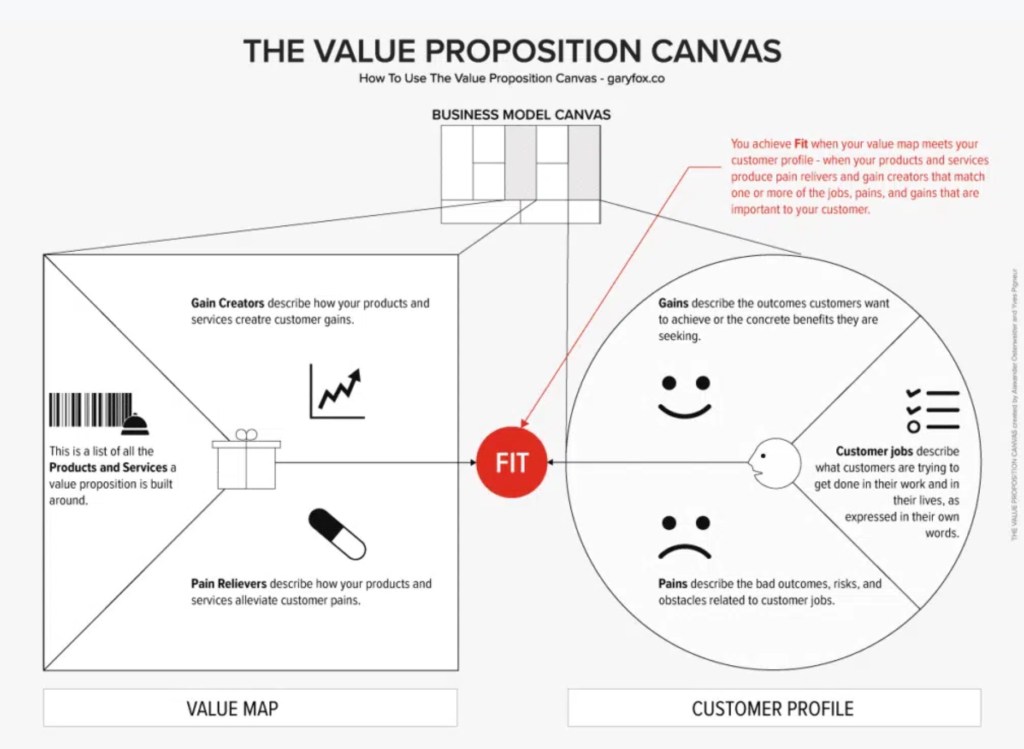
As you can see, it consists of two major sections:
- The Customer Profile (Right Side) – Describes your target customer, including their:
- Jobs (Tasks they need to complete)
- Pains (Challenges and frustrations)
- Gains (Positive outcomes they seek)
- The Value Proposition (Left Side) – Describes how your product or service helps customers by:
- Pain Relievers (How you solve their challenges)
- Gain Creators (How you provide value and benefits)
- Products & Services (Your offering that delivers value)
When these two sections align, you have a strong value proposition that clearly communicates why customers should choose your business over competitors.
Why is the Value Proposition Canvas Important?
✅ Customer-Centric Approach – Helps you understand what truly matters to your customers.
✅ Minimizes Risk – Reduces the chances of launching a product that doesn’t fit the market.
✅ Enhances Communication – Provides a clear and structured way to explain your value to customers and stakeholders.
✅ Improves Product-Market Fit – Ensures that what you’re building aligns with what your customers need.
Now, let’s dive into the step-by-step process of building a Value Proposition Canvas.
Step-by-Step Guide to Building a Value Proposition Canvas
Step 1: Define Your Target Customer
Start by defining who your ideal customer is. This can be based on market research, customer interviews, or existing data.
💡 Example: Imagine you’re building a productivity app for freelancers. Your target customers could be freelancers and remote workers who struggle with time management.
Once you have a target audience, break it down into the Customer Profile section.
Step 2: Create the Customer Profile
The Customer Profile consists of three parts:
1. Customer Jobs (What They Need to Do)
Identify the key tasks, problems, or responsibilities your customer needs to complete.
🔹 Functional Jobs: Practical tasks they need to complete.
🔹 Emotional Jobs: How they want to feel while doing it.
🔹 Social Jobs: How they want others to perceive them.
💡 Example (Freelancer’s Jobs):
- Organizing projects and tasks
- Managing time efficiently
- Communicating with clients
- Keeping track of invoices and payments
2. Pains (Challenges & Frustrations)
List the pain points, fears, and frustrations customers experience.
🔸 What makes their job difficult?
🔸 What are their biggest struggles?
🔸 What are they afraid of?
💡 Example (Freelancer’s Pains):
- Struggles with time management
- Feels overwhelmed with multiple projects
- Misses deadlines due to poor organization
- Loses money due to forgotten invoices
3. Gains (Desired Outcomes & Benefits)
Identify the positive outcomes customers want.
🔹 What do they hope to achieve?
🔹 How would they define success?
🔹 What improvements do they want in their lives?
💡 Example (Freelancer’s Gains):
- Increased productivity and focus
- Fewer missed deadlines
- More income from organized invoicing
- Better work-life balance
Step 3: Define Your Value Proposition
Now, move to the Value Proposition section and define how your product or service meets the needs of your customers.
1. Products & Services (What You Offer)
List the core products or services that provide value to your customers.
💡 Example (Freelancer Productivity App):
- Task and project management tool
- AI-powered time tracker
- Automated invoicing system
- Client communication dashboard
2. Pain Relievers (How You Solve Their Problems)
Describe how your product eliminates or reduces customer pains.
🔸 What frustrations do you remove?
🔸 How do you simplify their lives?
💡 Example (Freelancer Productivity App’s Pain Relievers):
- AI time tracking removes manual logging
- Smart notifications prevent missed deadlines
- Automated invoicing reduces administrative work
3. Gain Creators (How You Enhance Their Experience)
Explain how your product creates positive experiences and extra benefits for the customer.
🔹 How does it make their life better?
🔹 What extra value does it provide?
💡 Example (Freelancer Productivity App’s Gain Creators):
- Dashboard provides real-time project insights
- AI suggestions improve time management
- Professional invoicing system enhances credibility
How to Use the Value Proposition Canvas Effectively
Once you’ve built your Value Proposition Canvas, here’s how you can use it effectively:
✅ Test Your Assumptions – Conduct customer interviews and surveys to validate your findings.
✅ Refine Your Product – Make adjustments to your offerings based on real customer feedback.
✅ Communicate Your Value Clearly – Use it to craft compelling marketing messages.
✅ Align Your Business Strategy – Ensure all aspects of your business (marketing, sales, product) are aligned with the value proposition.
Real-World Example: Airbnb’s Value Proposition Canvas
Customer Profile (Travelers)
- Jobs: Find affordable, unique places to stay.
- Pains: Expensive hotels, lack of local experiences.
- Gains: Affordable, personalized stays with local hosts.
Value Proposition (Airbnb’s Offerings)
- Products & Services: Online platform for booking local accommodations.
- Pain Relievers: Cheaper than hotels, more authentic experiences.
- Gain Creators: Variety of housing options, easy booking system.
Airbnb successfully aligned their offerings with their customers’ needs, making them a global success.
Why You Should Use a Value Proposition Canvas
The Value Proposition Canvas helps businesses:
✅ Identify real customer needs
✅ Develop products with strong market fit
✅ Communicate their unique value clearly
✅ Stand out from the competition
Building a strong value proposition ensures that your customers see the true value of your product or service and are more likely to buy from you.
🚀 Ready to create your own Value Proposition Canvas? Feel free to reach out to http://www.dreieskiva.com for course and coaching: Start now and build something your customers truly love!
 DREIESKIVA|Roald Kvam
Legg igjen en kommentar